 Eurolight

Core pain points in Nigeria for LED football stadium floodlights: severe grid voltage fluctuations, high surges caused by frequent thunderstorms, high‑humidity corrosion in coastal areas, and high‑temperature sand‑dust environments in northern regions. Most projects are 11‑a‑side amateur/community football pitches, with a small number of school and semi‑professional venues; TV‑broadcast‑grade projects are rare. The selection covers five sections: electrical adaptability, environmental reliability, optical parameters, power & lighting layout, and common pitfalls to avoid.
1. Electrical & Power‑grid Adaptation (Top Priority for Nigeria)
- Voltage: Nominal local voltage is 230V 50Hz. The power grid suffers heavy fluctuations. Drivers shall support wide voltage AC 100‑265V. Single‑rated 220V products shall be avoided, as voltage drop and surge will easily burn out power supplies.
- Lightning & Surge Protection (Critical): Thunderstorms are frequent. Built‑in 6 kV surge protection, minimum 6 kV. Ordinary 4 kV surge protection leads to high failure rate in Nigeria. Prioritize sports‑specialized isolated drivers from reputable brands such as Meanwell, Philips, Sosen brand, etc.
- Flicker: Mobile‑phone shooting is common locally. Low‑flicker performance with flicker depth <3% is required for amateur pitches; ≤1% and PWM frequency>20 kHz for broadcast‑grade venues.
- Wiring: Extended output cables for on‑site outdoor wiring. No plug‑and‑play connectors; direct field wiring is preferred for engineering projects.
2. Environmental Reliability (Nigerian Climate Conditions)
- Ingress Protection: IP66 is preferred for a outdoor LED floodlight, minimum IP65. Heavy rainfall & high humidity in the south and sand‑dust in the north; IP65 is acceptable yet IP66 delivers much lower failure rate. IK08 or higher impact resistance to withstand impacts from footballs and flying debris.
- Heat Dissipation: Die‑cast aluminum fin‑type heat sink. Operating temperature range ‑20℃ ~ +60℃. High ambient temperature in northern Nigeria; poor heat dissipation will cause rapid lumen depreciation. Adopt separated driver compartment to prevent the driver from being heated by the LED light source.
- Corrosion Resistance: Electrostatic powder‑coated housing. Stainless steel fasteners.
Thin‑wall housings and plastic floodlights are not recommended; high ambient temperature will cause deformation and water ingress within 1‑2 years. fp
3. Optical Parameters, Classified by Mainstream Project Tiers in Nigeria
| Venue Class | Horizontal Illuminance | CRI(Ra) | CCT | Glare Rating UGR | Remarks |
|---|---|---|---|---|---|
| Community / Recreational Training Pitch | 200‑300 lux | ≥70 | 5000‑5700 K | ≤55 | Accounts for most projects in Nigeria |
| School / Amateur Competition Pitch | 300‑500 lux | ≥80 | 5000‑5700 K | ≤50 | Frequent short‑video shooting with mobile phones; Ra shall not be lower than 80 |
| Semi‑professional Competition Pitch | 500‑750 lux | ≥85 | 5000‑5700 K | ≤45 | Mainly for government tender projects |
| TV Broadcast‑grade Stadium | 1000‑1500 lux | ≥90 | 5000‑5700 K | ≤40 | Very few such projects in Nigeria |
- Optical Lens: Sports‑grade asymmetric lens is mandatory, beam angles 25° / 40° / 60°. Ordinary general‑purpose floodlights result in uneven illuminance and severe glare. IES / LDT photometric files shall be provided for Dialux lighting simulation for tender submissions, which is frequently requested for government projects in Africa.
- Glare Mitigation: Anti‑glare louvers / visors are recommended. Severe glare will cause complaints from players looking up for high‑flying balls.
- Luminous Efficacy: ≥140‑150 lm/W. Avoid exaggerated nominal parameters; third‑party photometric test reports shall be available.
4. Power Rating, Pole Height & Lighting Layout Reference for 11‑a‑side Standard Football Pitch
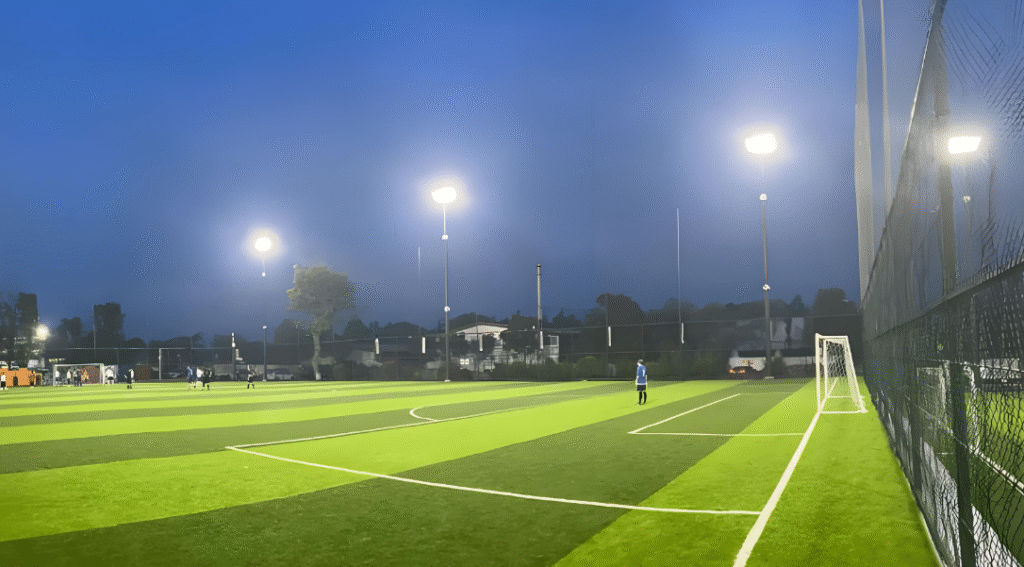
In Nigeria, stadium lighting poles are commonly 12‑18 m high. Four‑corner pole mounting is most widely adopted; side‑mounting is used for low‑budget projects.
- Community Training Pitch (4‑corner mounting, 4 poles, 12‑15 m height): 500‑600 W per luminaire, 2‑3 fixtures per pole, total system power 2000‑3600 W.
- School Amateur Competition Pitch (4 poles, 15‑18 m height): 600‑800 W LED floodlights, 3‑4 fixtures per pole, total system power 2400‑3200 W.
- Semi‑professional Stadium: 800‑1000 W per luminaire, 4‑6 fixtures per pole.
- Community Training Pitch (4‑corner mounting, 4 poles, 12‑15 m height): 500‑600 W outdoor floodlights, 2‑3 fixtures per pole, total system power 2000‑3600 W.
- School Amateur Competition Pitch (4 poles, 15‑18 m height): 600‑800 W per luminaire, 3‑4 fixtures per pole, total system power 2400‑3200 W.
- Semi‑professional Stadium: 800‑1000 W stadium floodlights, 4‑6 fixtures per pole.
5. Common Pitfalls for Nigeria Market
- ❌ Do not apply general‑purpose floodlights for stadium lighting: poor light distribution leads to uneven illuminance and failed acceptance by end‑users.
- ❌ Avoid 6 kV surge protection: high thunderstorm exposure in Nigeria causes high product failure rate; 10 kV surge protection is strongly advised.
- ❌ Avoid single‑rated 220 V input; grid fluctuation will trigger mass power‑supply failures.
- ❌ No overstated power and lumen output: local contractors will conduct on‑site illuminance measurement; falsified parameters will damage business reputation.
- ✅ Provide IES photometric files, LM‑80 lumen‑maintenance reports and third‑party test reports, which are essential for tender bids.
- ✅ Warranty term: industry mainstream is 3‑5‑year warranty. After‑sales service cost is high in Nigeria; product reliability shall be prioritized.
- ✅ Optional feature: 0‑10 V dimming function. Dim down for training sessions and full power for matches, which is increasingly preferred by local clients for power‑saving purposes.