 Eurolight

As Africa’s largest economy, Nigeria is home to a vast number of cement plants, construction material factories, food and beverage facilities, garment manufacturing plants, breweries, petrochemical plants, and packaging factories. Choosing LED lighting for these manufacturing factories in Nigeria is not the same as choosing lighting for a factory in Europe or China. The building is only half the story. What really decides whether an LED fixture survives—and pays for itself—is the environment it has to work in: unreliable grid power, generator and solar hybrid supply, harmattan dust, heat, humidity, and voltage swings that would destroy most imported drivers.
This guide covers the conditions inside a Nigerian factory, the specifications that actually matter, and a practical approach to choosing factory LED lights that will hold up for years
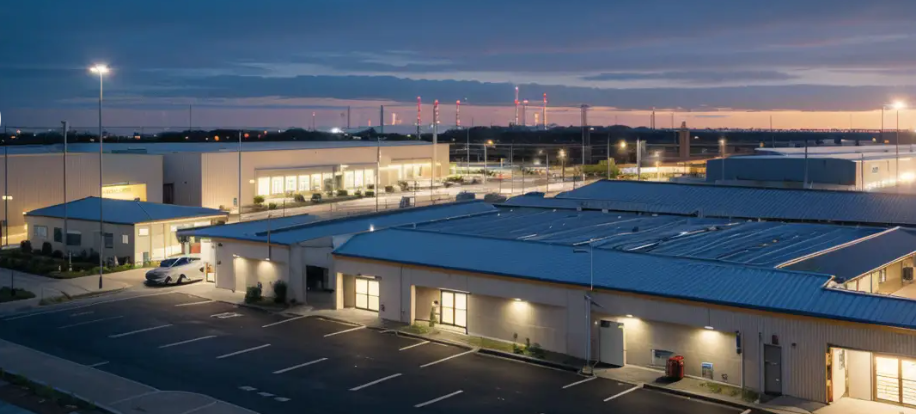
The reality inside a Nigerian factory
Before choosing any light, it helps to understand the conditions it will live in.
1. Power is expensive and unreliable
Nigeria’s grid is the single biggest constraint on industrial operations. According to the Manufacturers Association of Nigeria (MAN), manufacturers spent an estimated ₦1.34 trillion on alternative, self-generated power in 2025—a 21% jump from ₦1.11 trillion the year before—as factories leaned on diesel generators and off-grid solutions to keep production running.
The cost burden is severe. When diesel prices surged past ₦2,000 per litre, energy reportedly consumed as much as 50% of some manufacturers’ operating expenditure. Compare electricity costs: an industrial user in Vietnam pays roughly 8 US cents per kWh and one in China about 10 cents, while a Nigerian manufacturer pays about 15 cents on the national grid—and close to 30 cents when diesel generation is added in.
The practical takeaway: every watt counts. Cutting your lighting load is not a small saving—it directly reduces the fuel bill that dominates your operating costs.
2. Voltage swings are the norm, not the exception
Power quality in Nigeria is poor. Documented problems include voltage sags, voltage swells, harmonic distortion, flicker and phase imbalance. Field measurements on the nominal grid (230V single-phase / 415V three-phase, 50Hz) have recorded wide swings outside the acceptable ±10% band; one industrial deployment in Lagos saw sags toward 140V and surges toward 280V on a 220V nominal supply.
What does this mean for lighting? A cheap LED driver built for a narrow, stable input voltage (say 220–240V) will fail early or flicker. A driver with a wide input voltage range and surge protection is effectively built-in insurance against the grid and generator switching that happens daily.
3. Dust, heat and humidity are constant
- Harmattan dust (roughly November to February) blows fine, abrasive dust across most of the country, especially heavy in the north.
- Coastal humidity in Lagos, Ogun and the Rivers/Port Harcourt axis is high and persistent.
- Ambient heat inside metal-roofed, poorly insulated factory sheds can climb well above comfortable levels during the dry season.
These are not minor annoyances. Dust that settles inside a fixture reduces light output and traps heat; humidity corrodes contacts; heat degrades LED drivers and accelerates lumen depreciation. Fixture sealing and thermal design matter far more than the lumen figure on the box.
4. Manufacturing factories cluster in specific zones
Nigerian manufacturing is not spread evenly. Most industrial capacity sits on the Lagos–Ogun axis (Ikeja, Apapa, Lekki Free Zone, and Ogun’s Agbara, Ota, Mowe–Ibafo corridor, plus the Ogun–Guangdong and Gateway Free Trade Zones). Kano and Kaduna anchor the north with cement, agro-processing, textiles and fertilizer blending. Port Harcourt is the oil-and-gas hub, and Aba drives small-scale manufacturing. Purpose-built zones like the Lagos Free Zone, Calabar Free Trade Zone, Enyimba City and Ibom Industrial City are growing fast.
Different zones mean different dust, humidity, mounting heights and hazard profiles—so “one fixture for the whole plant” is rarely the right answer.
Why LED is the right upgrade for Nigerian factories
If you are still on metal halide (HID), fluorescent or old halogens, the case for switching to LED is straightforward:
- Lower wattage, same or better light. A modern LED high bay delivers comparable illumination to a metal halide fixture at roughly half to a third of the wattage. Given Nigeria’s energy cost, the monthly saving is real and immediate.
- Longer life. Quality LED fixtures are rated at 50,000 hours or more, versus around 8,000–15,000 hours for metal halide. Fewer replacements matter when every shutdown costs production time and labour.
- Instant on, no warm-up. Metal halide takes minutes to reach full brightness and restrikes slowly after a power cut. LEDs switch on instantly—important where power cuts and generator changeover are routine.
- Better control. LEDs dim cleanly, pair with motion sensors, and can be switched by zone, so you light only the areas where people are working.
- Cooler operation. LEDs radiate less heat than HID, lowering the cooling load inside hot factory sheds.
What LED lights are the best for manufacturing factory in Nigeria?
High bay, linear, or tri-proof? Matching the fixture to the space
High bay LED lights
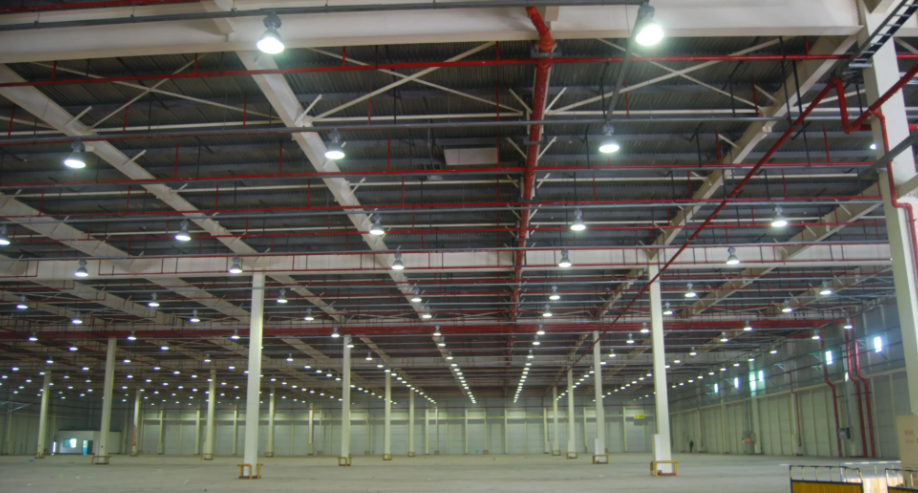
The workhorse for factories, warehouses and production halls with ceilings above 6–8 metres. UFO-style high bays with aluminium housings, IP65+, wide voltage and a choice of beam angles cover most general manufacturing floors. For typical Nigerian shed heights, a 150W–240W unit is the most common pick—the 200W warehouse high bay light from Eurolight (Breco Lights Nigeria) is a popular example, and the LED high bay covers from 100W up.
Industrial batten (tri-proof) lights
For lower ceilings, corridors, packaging lines and damp or dusty processing areas, sealed linear tri-proof fittings (waterproof, dustproof, corrosion-resistant) are often the better choice. They mount close to work height, daisy-chain easily, and shrug off the same dust and humidity—the LED tri-proof light is built for exactly these spaces.
Retrofitting fluorescent tubes
Many Nigerian factories still run fluorescent battens. If the ceiling is low and the wiring is already in place, the cheapest fast win is often to swap the tubes rather than the whole fixture—T8 LED tube lights and T5 batten options slot into existing fittings and cut energy use dramatically.
A practical rule of thumb: high bay for tall open spaces such as warehouse, package area, operation areas etc, tri-proof lights ( surface mounted weatherproof LED luminaire fixtures) for low or dusty areas or production line, and a mix of both for a typical multi-zone factory.
Choosing by Nigerian zone
- Lagos–Ogun (Lekki, Ikeja, Apapa, Agbara, Ota, Mowe–Ibafo, Ogun–Guangdong, Gateway FTZ): coastal humidity plus dense industrial use. Prioritise IP65/IP66, wide-voltage drivers, and fixtures tolerant of salt-air corrosion. This axis covers the majority of the country’s addressable factory lighting spend—and it is exactly where Eurolight’s Lagos warehouses are based.
- Kano / Kaduna (north): agro-processing, cement and textiles. Harmattan dust is the dominant risk. Emphasise fully sealed (dust-tight) IP65+ housings and impact resistance against abrasive airborne dust.
- Port Harcourt / Rivers (oil & gas): heavy humidity and washdown. Choose IP66/IP67 with corrosion-resistant bodies; for hazardous-classified areas you will need certified explosion-proof (ATEX/IECEx) fixtures—do not substitute standard industrial LEDs.
- Aba and small-scale hubs: cost-sensitive retrofit environments. Here the priority is high efficacy and durable wide-voltage drivers so the saving per naira spent is maximised and maintenance is rare.
For factory yards, loading docks and perimeter security, add LED floodlights (100W or 200W) and, for access roads, LED street lights.
Working with generators and solar (hybrid power)
Many Nigerian factories run on diesel generators, increasingly blended with hybrid solar. Lighting interacts with this in two ways:
- Load reduction. Because lighting is often a large share of a factory’s electrical load, cutting it directly reduces generator fuel burn and battery or solar demand. Lower-wattage LEDs and occupancy-sensor dimming can shrink the lighting share of your energy bill noticeably.
- Power quality stress. Generator start/stop and inverter transitions create voltage transients. Wide-voltage drivers with surge protection ride through these transitions without flicker or failure—another reason the driver spec is your top priority.
Don’t forget emergency lighting. With routine outages, battery-backed exit and emergency lights are a safety essential.
Buying locally vs importing
For most Nigerian factories, buying locally beats importing: freight, customs and lead time disappear, and you get someone who will stand behind the product. Breco Lights Nigeria (Eurolight) is an LED light vendor, manufacturer and supplier in Lagos, operating since 2010 as the local partner of GRNLED from China. What makes them practical for factory projects:
- Local stock in two Lagos warehouses covering high bay, triproof, panel, floodlight, street and landscape lighting.
- A lighting design service that plans lux levels and layouts for your specific building before you commit.
- Branded LED chips and drivers, which keeps drivers reliable on Nigeria’s unstable power.
- One-stop service: they can supply, install and maintain the whole lighting system, with no MOQ.
- After-sales and warranty support handled locally.
Final buying checklist for Nigerian manufacturing factory LED lighting
- Driver: wide input voltage range (220-240VAC at least) and surge protection (non-negotiable).
- IP65 minimum; IP66/IP67 for coastal, humid or washdown zones.
- IK08+ impact resistance for industrial floors.
- 5000K–6500K CCT for production areas.
- Compare lumens and lm/W, not wattage.
- Beam angle matched to your mounting height (60/90/120°).
- Good aluminium thermal design and a wide operating range for Nigerian heat.
- 3–5 year warranty from a supplier who can honour it locally.
- Plan by zone: high bay for tall halls, tri-proof linear for low or dusty areas, certified ATEX where hazardous.
- Buy from a local Lagos supplier with stock, design and installation support.
FAQ
What IP rating do I need for a Nigerian factory?
IP65 is the minimum for dust-tight production and warehouse areas. Use IP66/IP67 in coastal, humid or washdown environments, and higher washdown ratings (IP69K) only where regular jet cleaning happens.
Is LED cheaper to run than metal halide in Nigeria?
Almost always. LEDs deliver comparable light at a fraction of the wattage, and with Nigeria’s high energy cost the saving directly reduces your grid or diesel bill.