 Eurolight

With the development of LED chip technology, LED lights are getting brighter and brighter, and the uncomfortable glare is becoming more and more serious. In order to obtain a comfortable and high-quality lighting environment, it is necessary to choose anti-glare LED lights, especially indoor lamps. In recent years, many countries and regions, such as the European Union, have anti-glare standards for indoor LED lights, that is, UGR (Unified Glare Rating) <19, or even lower.
What is UGR of LED lights?
The Unified Glare Ratio (UGR) is a subjective psychological parameter developed by the International Commission on Illumination (CIE) to quantify the discomfort caused to the human eye by indoor lighting fixtures. Its value is calculated using the unified glare formula published by the CIE, and the higher the value, the more significant the glare effect. This parameter has been incorporated into the architectural lighting design standard and is widely used in the evaluation of lighting quality in office, educational, and industrial settings [1] [3]. Glare effects are divided into three categories: discomfort, light adaptation, and disability. The UGR value is affected by multiple factors such as the brightness of the light source, its location, and the ambient brightness. Current standards require that the UGR value of healthy lighting locations be lower than 19.
Unified Glare Rating (UGR) is an important indicator for measuring the level of glare from lighting fixtures. When choosing lighting fixtures, low glare is key to protecting your eyes.
UGR requirements for different LED lighting applications
UGR for several types of venues as defined by the CIE (International Commission on Illumination).
| Application area | LED lights types | UGR requirements |
| Factory, power plant, monitoring room | LED high bay lights or surface mouted weatherproof LED luminaires | 16 |
| Airport, control tower | High power LED downlights, LED high bay lights | 16 |
| Daily office space | LED panel lights, deep LED downlights | 19 |
| Meeting rooms | Anti glare downlights, Backlit LED panel lights | 19 |
| Schools | LED panel lights, LED Tube lights | 19 |
| Hospitals | Adjustable LED spotlights, LED panel lights | 19 |
| Convenience store, sales area | Suspension linear LED lights, Recessed downlights | 22 |
| Restaurants, hotels, dining areas, and banquet halls | Deep recessed downlights, wall washer led spotlights, surface LED Downlights. | 22 |
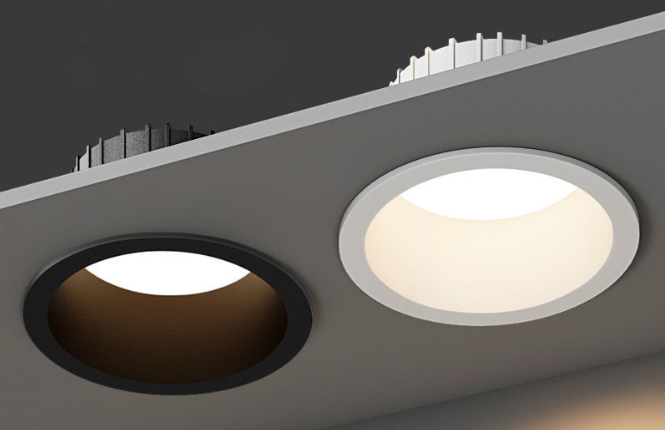
The commonly stated “UGR < 19” only meets the most basic glare requirements for places like schools and offices. In actual use, customers tend to prefer LED light fixtures with lower UGR values. Looking at the table below showing the correspondence between UGR values and the degree of uncomfortable glare, you’ll understand: UGR = 19 actually represents uncomfortable glare. The lower the UGR value, the better for work and study environments.
| UGR Value | Discomfort glare level |
| 28 | Severely glaring |
| 25 | glaring |
| 22 | Slightly dazzling |
| 19 | Disomfortable |
| 16 | Feeling slightly uncomfortable |
| 13 | Slight discomfort |
Many people misunderstand UGR, believing it to be a parameter of the luminaire itself, like wattage and luminous efficacy. In fact, UGR refers to the discomfort of the lighting environment for the human eye. It’s a value calculated from various parameters related to glare generation, characterizing the level of uncomfortable glare in the entire illuminated space. Simply put, the UGR value is not only related to the luminaire, but also to the room size, the room’s reflectivity, and the observer’s viewing direction.
If you have any questions or problem for your lighting design for your projects, just welcome to inquiry us. Eurolight will provide the best service and LED lights.