 Eurolight

Why lighting is a supermarket's secret weapon
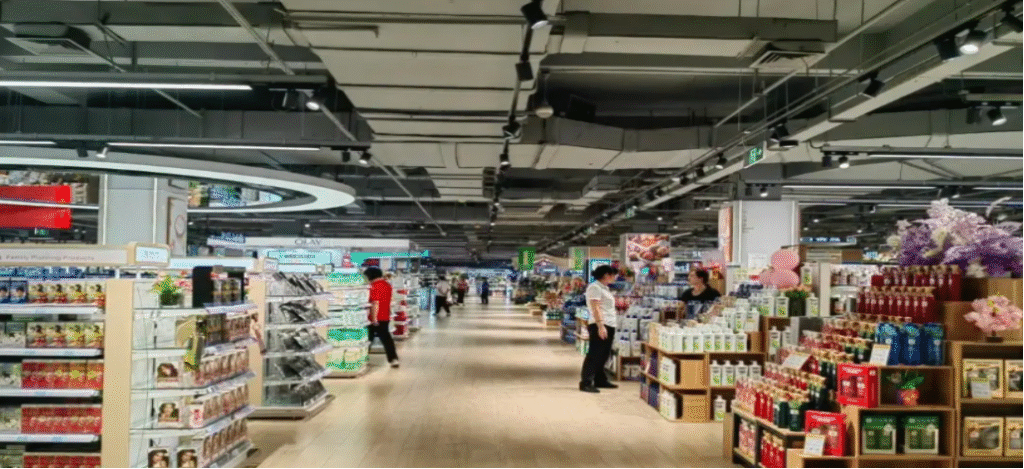
Supermarket owners in Nigeria usually focus on stock, buying prices and foot traffic — and overlook one detail that quietly moves revenue: the supermarket lighting design. Put the same products under the right light and the difference is dramatic: fresh produce looks juicy and glossy, labels on packages are easy to read, aisles feel bright instead of cramped, and the checkout runs smoothly without errors.
More importantly, a typical Nigerian supermarket is open 10–14 hours a day, making lighting one of the most continuous and predictable operating costs. Choosing the right fixtures is not just about “looking brighter” — it directly affects your monthly electricity bill, lamp life, maintenance cost, and the very first impression customers form of whether your store is clean and fresh. This guide walks through the store layout of a real Nigerian supermarket and explains, step by step, how to pick LED lights for supermarkets that are dependable and cost-effective.
Three lighting challenges unique to Nigerian supermarkets
Supermarket LED lighting in Nigeria cannot simply copy the generic schemes used in Europe or America. The local environment has a few realities that decide your lighting fixture selection:
Unstable grid & voltage surges
Nigeria’s grid often suffers voltage fluctuation, surge impacts and momentary outages. Ordinary plastic driver power supplies have no overvoltage protection and burn out easily, causing flicker, dimming or total failure. Surge protection in the driver is a must.
Heat & humidity accelerate aging
Year-round hot, humid weather lets moisture into fixtures, causing short circuits, mold on LED beads, faster aging of light guides and panels that yellow or darken within months. Heat dissipation and moisture resistance are hard requirements.
Frequent outages & backup needs
Power cuts are common in Nigeria. Supermarkets need emergency lighting to keep escape routes safe and checkouts running — a compliance and safety must.
In short, the rule for choosing lights in Nigeria is: local adaptability comes first, price-to-value comes second. Buying on unit price alone usually means “cheap to buy, expensive to run.”
Zone-by-zone selection overview (quick reference)
A supermarket is large and divided into many zones, each with completely different light needs. Start with the overview, then we break it down zone by zone:
| Store zone | Recommended fixtures | Color temp. | Illuminance | Key selection points |
|---|---|---|---|---|
| Entrance / Welcome | LED panel lights, LED downlighter | 4000K | 500–800 lx | Bright and welcoming, fast first impression |
| Main aisles / Shelves | LED panel lights, track lights | 4000K | 300–500 lx | Even, glare-free, guides the flow |
| Fresh produce | Track spotlights, high-CRI downlights | 4000–4500K | 600–1000 lx | High CRI, restores a fresh, dewy look |
| Meat & seafood | Full-spectrum fresh lights, track lights | 3000–3500K | 750–1500 lx | High CRI + R9, red meat, no grey tint |
| Deli & bakery | Track lights, spotlights | 3000–3500K | 600–1000 lx | Warm light boosts appetite and gloss |
| Frozen & chilled | Cool-white panels, shelf lights | 5000K+ | 600–1000 lx | Cool white reads clean; no UV/IR on strips |
| Checkout / Work | LED panel lights, downlights | 3000–4000K | 500–750 lx | Clear, shadow-free, comfortable |
| Warehouse / Back-of-house | Tri-proof lights, high bay lights | 5000–6000K | 200–400 lx | Bright, durable, moisture-proof |
How to choose lighting for each store zone
Entrance & welcome area: the “likeability switch”
The first three seconds decide whether a customer wants to keep browsing. For the entrance, use LED panel lights or LED downlights as general lighting at 4000K neutral white, bright enough (500–800 lx) to feel clear without glare — a bright, clean, welcoming first impression.
Main aisles & shelf area: even, glare-free, with flow
This is the largest area and the heart of supermarket lighting design. Aisle lighting must be uniform and anti-glare so customers can look up at shelf labels without being dazzled. Use high-efficiency LED panel lights for general ceiling lighting, plus LED track lights to precisely light the goods on the shelves. Keep the color temperature at 4000K and illuminance at 300–500 lx. The more even the light, the easier customers find products — and the longer they stay.
Fresh produce area: restore that “fresh” dewiness
Fresh produce is the highest-margin zone and the one most sensitive to light. Use 4000–4500K natural white light with high-CRI fixtures, aiming for a Color Rendering Index (CRI) of 90 or above, so leafy greens stay vivid, fruit looks bright and skin stays dewy. Avoid yellowish light that makes vegetables look wilted, or overly white light that makes fruit look grey.
Meat & seafood area: the secret to “red” freshness
Meat and seafood call for 3000–3500K warm white, or even full-spectrum fresh-meat lights with special red chips that enhance the red of the meat while keeping fat white, not grey. The key spec to check is R9 (red rendering). Strips inside chilled cabinets must also be free of UV and infrared, which would accelerate meat oxidation.
Deli & bakery area: use warm light to spark appetite
For deli, bakery and pastry, 3000–3500K warm yellow track lights highlight the glossy, oily sheen of food, spark appetite and create a cozy atmosphere. Use 600–1000 lx, bright on featured products with slightly darker surroundings for depth.
Frozen & chilled area: cool white reads “clean”
Freezer and chilled zones benefit from 5000K+ cool white for a sense of cleanliness and transparency. Fixtures must resist moisture and condensation, and strips should avoid UV/IR so produce stays fresh. This is one of the zones where IP rating matters most in Nigeria’s heat.
Checkout & work area: clear, shadow-free
The checkout needs 500–750 lx of working light so cashiers can scan, make change and check clearly without shadows, and customers can read the transaction. LED panel lights arranged evenly above the counter do the job, at 3000–4000K, soft and non-glare.
Warehouse & back-of-house: practical and durable first
The warehouse, stockroom and staff corridor need no frills — just bright, stable, heat- and moisture-resistant basics. LED tri-proof lights and LED high bay lights are ideal, at 5000–6000K and 200–400 lx.
Choosing the right fixture types
A supermarket is rarely lit by one fixture alone — it is a combination of general lighting + accent lighting + emergency lighting. These are the most common and practical choices for a Nigerian supermarket:
- LED panel lights: spread even, soft, bright light across the ceiling. Ideal for large areas — entrance, aisles, checkout and office. Ultra-thin and frameless models look clean and are easy to maintain.
- LED downlights: recessed or surface-mounted, compact and flexible for entrances, aisles and accent fill. Deep anti-glare downlights reduce glare when looking up.
- LED track lights / magnetic track lighting: adjustable angle, ideal for precisely lighting shelves, end caps, promo displays and key fresh items — the core of accent lighting. Magnetic track systems let you add or move fixtures easily.
- LED tri-proof lights (moisture, dust, corrosion): sealed and resistant, for kitchens, warehouses, parking and other humid or dusty zones.
- LED high bay lights: bright, high-mounted, for tall warehouses and back-of-house areas.
- Emergency lighting: switches on automatically during outages to keep escape routes and checkouts running — a key part of compliance and safety in Nigeria.
For more detail on specific fixture types, see our complete guide to LED track lights in Nigeria, the difference between LED downlights and spotlights, and the details of LED magnetic track light systems.
Five core specifications explained
If you cannot read the specs, low prices and sales talk will lead you astray. When choosing supermarket LED lights, focus on these hard numbers:
1. Color Rendering Index (CRI) — the higher, the truer
CRI measures how faithfully a light reproduces true colors. In a supermarket that sells on “fresh color,” aim for CRI ≥ 80 in the shelves and general goods, and CRI ≥ 90 — even pay attention to R9 — in fresh areas. To understand it fully, read everything about CRI of LED lights in Nigeria.
2. Color temperature (CCT) — sets the mood
4000K neutral white is the most versatile for aisles and shelves; 3000–3500K warm white suits fresh produce and deli; 5000K+ cool white fits frozen zones and warehouses. Pick the wrong color temperature and food looks yellow and wilted, or pale and grey. See how to choose CCT color temperature.
3. Luminous efficacy (lm/W) — decides the electricity bill
Higher efficacy means more light per watt. Choose ≥ 90 lm/W and you save 30%–50% on electricity at the same brightness versus poor low-efficiency lamps. With a Nigerian supermarket running 10+ hours daily, this adds up to the biggest long-term saving.
4. Anti-glare UGR — protects the customer experience
When customers look up for products and are dazzled, the experience suffers. Choose low-UGR (Unified Glare Rating) deep anti-glare fixtures for soft, comfortable light. See what you need to know about UGR.
5. IP rating & safety
For frozen zones, kitchens and warehouses, check the IP rating (e.g. IP44/IP65) for dust and water resistance; look for CE certification and V-0 flame-retardant internals, plus surge protection in the driver, so fixtures run safely and stably in humid conditions.
Two more specs worth knowing: THD (total harmonic distortion) affects grid load and stability (what is THD of LED lights), and a fixture’s Class I / II / III insulation class (Class I, II and III for LED lights).
Common mistakes to avoid
- Judging brightness by wattage: higher wattage does not mean brighter. Poor low-efficiency lamps only add to the electricity bill. Look at luminous efficacy (lm/W).
- Chasing ultra-low prices: products far below the market average almost always cut corners on heat sinks, LED chips and drivers — costing far more in maintenance and replacement later.
- Copying generic European/American fixtures: standard lamps built for stable grids and mild climates lack surge and moisture protection, and fail often in Nigeria.
- Buying without a formal warranty: unbranded bulk goods have no standardized after-sales. Choose a proper supplier — after-sales and warranty are what really control long-term cost.
- Using one fixture for the whole store: supermarkets have many zones with very different needs. Use a layered combination of general + accent + emergency, not one light everywhere.
To understand how to source truly reliable lights in this market from the ground up, start with how to buy good LED lights in Nigeria and how to buy cost-effective LED panel lights (complete guide).
Conclusion
Choosing LED lights for supermarkets in Nigeria is really one combined decision of “environment adaptation + zone planning + long-term cost.” Start from the realities of the local grid and climate, configure each zone — entrance, aisles, fresh, deli, frozen, checkout, warehouse — and cover surge protection, high CRI, anti-glare, moisture resistance and emergency lighting. That is how your supermarket shines professionally while saving money.
Breco Lights Nigeria (Eurolight) has been a professional LED lighting vendor, manufacturer, and solutions provider in Lagos since 2010, with a large local stock warehouse for fast delivery and installation and maintenance services. We supply LED panel lights, LED downlights, LED track lights, magnetic track lighting, LED tri-proof lights, LED high bay lights, and emergency lights, all adapted for Nigeria’s commercial and industrial use.